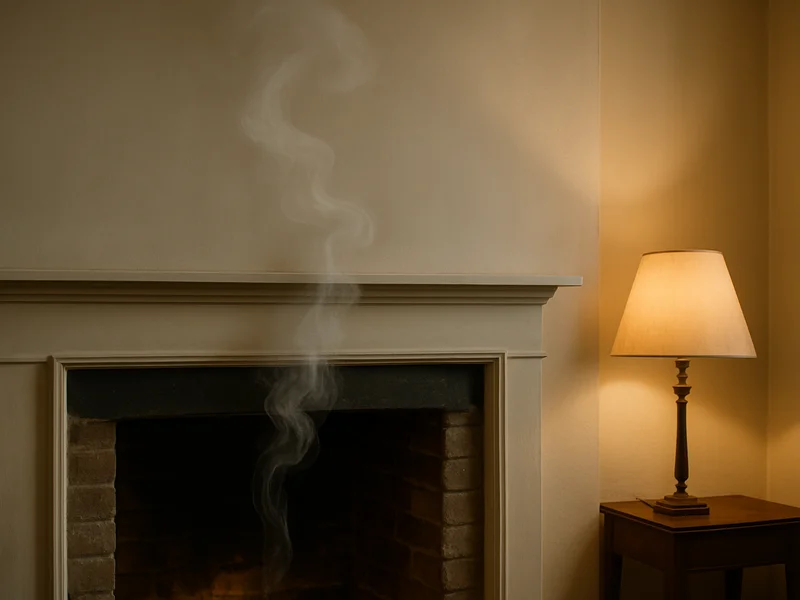
The fireplace that works all winter and then spills for a week straight.
Rapid City occupies a basin where the creek breaks out of the hills, with the hogback ridge rising on the western side. It is a fine place to put a town and an awkward one for a chimney.
Under settled winter high pressure, cold dense air pools on the valley floor while the air a few hundred feet up stays warmer. That is a temperature inversion, and it is precisely the opposite of the condition a chimney depends on. Draft exists because the gas inside the flue is less dense than the air outside it. Remove that difference and a flue that has behaved impeccably for years simply stops pulling.
Owners describe it as the fireplace suddenly going wrong, and it is not the fireplace. The giveaway is the pattern: it spills for several days in a row, always in still cold weather, and then behaves perfectly again. A genuine chimney fault does not come and go with the barometer.
The trap is that this is the point at which somebody sells a cap. A cap addresses wind-induced downdraft, which is a different problem entirely, and on an inversion it changes nothing.
What genuinely helps is margin. A correctly sized, insulated flue keeps the exhaust hot enough to establish a column even when the outside air is working against it - which is why the fix for recurring inversion spilling is frequently relining rather than anything bolted to the top. We will tell you when that is the honest answer and when it is not worth it.
The free version, worth trying tonight: warm the flue with a rolled newspaper held up the throat for a minute before lighting. On an inversion day that alone is often enough.
Still and cold, or windy? Extractor running? Those answers are most of the diagnosis.
Rather talk it through
Tell us the conditions when it happens. That single detail narrows the cause before we arrive.